Argument Based on the February 23, 2021 Text Conversation
The February 23, 2021 Base manager, Monique Williams, text conversation is significant evidence that United knowingly proceeded toward termination despite the fact that no investigatory meeting had occurred. In the conversation, United personnel expressly acknowledged: “We never were able to hold an investigation meeting.”
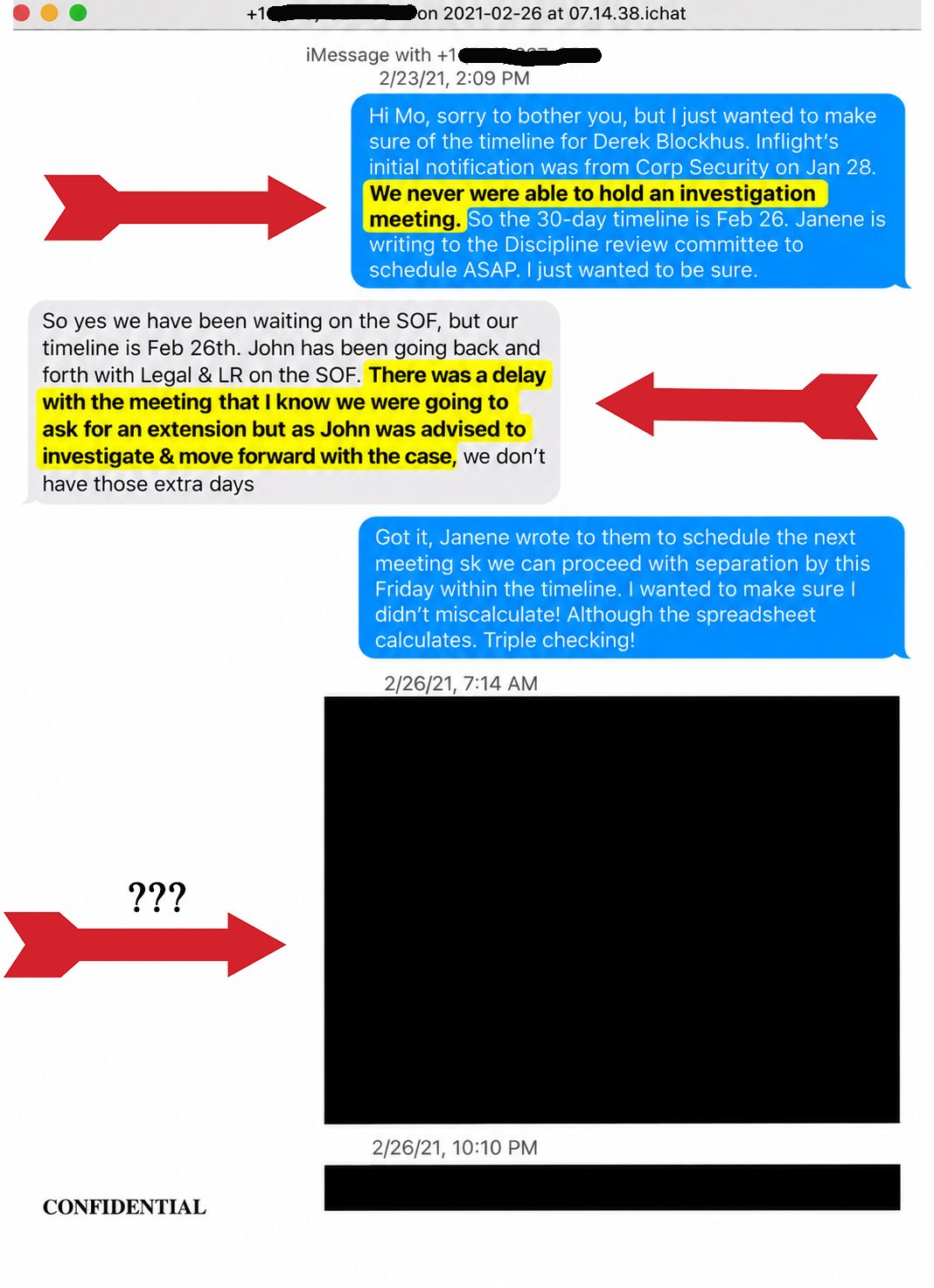
That admission confirms that United had not completed the contractual investigation before making its termination decision. The same conversation states that the company was “proceed[ing] with separation by this Friday,” February 26, while acknowledging that the investigation meeting had been delayed and that the parties had been “waiting on the SOF.” United’s termination letter separately confirms that the February 8 and February 15 investigatory meetings did not occur and that the Company knew I was unavailable until at least April 5, 2021.
Violation of JCBA Section 23.A.1
JCBA Section 23.A.1 provides:
“When the company conducts an investigation which may lead to disciplinary action or discharge, the Flight Attendant shall be entitled to Union representation, if reasonably available, and an opportunity to present information relevant to the investigation.”
The text conversation demonstrates that United treated the investigation as incomplete but nevertheless made a deliberate decision to terminate FA Blockhus before the required meeting could occur. The Company did not merely reach an adverse conclusion after a completed investigation; it accelerated separation to meet an internal February 26 deadline.
That violated the substance of Section 23.A.1 because I was never given a meaningful opportunity, with union representation, to:
- respond to the allegations;
- explain the disputed text messages and their context;
- challenge the completeness or authenticity of the communications;
- present phone, WhatsApp, SIM-card, or other records;
- address FA Lense’s credibility and stated employment-related concerns; or
- explain my February 7 statement before United relied upon it.
The conversation shows that the omission was not accidental. United knew the meeting had not occurred, knew there had been a delay, and nonetheless directed that the case proceed toward separation. The contractual right to present relevant information cannot be satisfied by providing documents alone when the employee is terminated before being interviewed or permitted to respond.
United Prioritized the Deadline Over the Contractual Process
The conversation indicates that United’s concern was completing separation by the February 26 deadline:
“Janene wrote to them to schedule [the next meeting] so we can proceed with separation by this Friday within the timeline.”
This language supports the argument that United prioritized an internal deadline over FA Blockhus contractual right to participate in the investigation. The Company had options short of termination, including requesting or granting an extension, postponing the meeting until FA Blockhus medical unavailability ended, or preserving the investigation while awaiting the required meeting. Instead, it proceeded with termination while the investigation remained unfinished.
The same conversation acknowledges that the meeting had been delayed and that an extension had been contemplated:
“There was a delay with the meeting that I know we were going to ask for an extension.”
That statement is important because it contradicts any suggestion that I simply refused to cooperate or intentionally caused the investigation to fail. The delay was known to United personnel, and an extension was under consideration. The record further states that FA Blockhus medical documentation was timely submitted and that AFA understood the investigation would be paused pending information concerning FA Blockhus medical status.
The Termination Was In Absentia and Prejudicial
United’s decision to proceed was especially prejudicial because it knew FA Blockhus would not be available for an investigatory meeting until at least April 5, yet terminated him on February 26—more than five weeks earlier. The Company could not fairly characterize FA Blockhus nonattendance as a refusal to participate when its own records identified medical unavailability as the reason the meetings did not occur.
The text conversation therefore supports the following sequence:
- United received the initial complaint and opened an investigation.
- The scheduled investigatory meeting did not occur.
- A second meeting also did not occur.
- United personnel acknowledged that no investigation meeting had been held.
- United recognized that the meeting had been delayed and that an extension had been considered.
- United nevertheless decided to complete separation by February 26.
- United terminated FA Blockhus before he could attend the meeting or present a defense.
That sequence establishes a direct connection between the contractual violation and the termination. Had United waited for the meeting, FA Blockhus could have presented evidence materially challenging the allegations and the Company’s interpretation of the communications.
Deadline Defense
United may argue that February 26 was the applicable deadline and that the Company had to act before the investigation period expired. The text conversation undermines that defense in two respects.
First, the conversation confirms that United knew the meeting had not occurred. Second, it confirms that the parties recognized a delay and contemplated an extension. A contractual deadline should not be used to justify denying an express contractual right to participate in an investigation, particularly where the delay was connected to medical unavailability and was known to the Company.
At minimum, the deadline required the parties to address the appropriate extension or procedural remedy. It did not authorize United to terminate an employee sight unseen after acknowledging that the investigation meeting had never taken place. United believed the contractual period could not be extended, it should have preserved the employee’s participation rights through an agreed extension, a later meeting, or another procedure consistent with the JCBA.
Conclusion
The February 23 text conversation is powerful corroborating evidence that United knowingly terminated FA before completing the investigation required by JCBA Section 23.A.1. United personnel expressly acknowledged that no investigatory meeting had occurred, recognized that the meeting had been delayed, and nevertheless sought to complete separation by February 26.
The conversation supports the conclusion that the termination was driven by an internal deadline rather than a completed, fair, contractually compliant investigation. Because FA Blockhus was never interviewed, never permitted to present relevant information, and was terminated while medically unavailable, United violated the JCBA’s express investigatory protections. AFA should therefore treat the conversation as grounds for re-review, challenge the premature termination, and pursue rescission, reinstatement, back pay, restoration of seniority and benefits, and all other remedies available under the Agreement.