Case Summary:
Blockhus
v.
United Airlines
When Allegations Replace Evidence,
Violation of Written Employment Contract
JURISDICTION AND VENUE
FA Blockhus Union Association of Flight Attendants (AFA)
FA Blockhus respectfully requests that the Association of Flight Attendants (AFA) conduct a renewed and impartial review of his grievance and the circumstances surrounding his termination from United Airlines. This request is based upon substantial concerns regarding procedural irregularities, incomplete investigation practices, and the apparent failure to fully apply the contractual and statutory protections afforded to him under both the Collective Bargaining Agreement and federal law.
Under the Railway Labor Act, a union serving as the exclusive bargaining representative of employees owes its members a legal Duty of Fair Representation. Courts have consistently held that a union must represent its members in a manner that is not arbitrary, discriminatory, or conducted in bad faith. This includes an obligation to investigate grievances in a meaningful manner, fairly evaluate evidence, and make reasoned decisions regarding the handling of disciplinary disputes and arbitration proceedings.
FA Blockhus respectfully submits that several aspects of his case warrant renewed review under these principles, including:
- the decision to proceed with the investigation while he was medically unavailable and on approved FMLA leave,
- the failure to interview him prior to termination,
- the reliance upon disputed and unauthenticated evidence,
- the failure to fully evaluate exculpatory evidence and witness testimony,
- and the apparent deviation from established investigative and contractual procedures.
- documented harassment by FA Lense
- FA Lense testimony stating "I was only trying to protect my job"
Courts and labor arbitrators have long recognized that disciplinary action lacking procedural fairness or consistent application of standards may undermine a finding of just cause. This is especially true where long-tenured employees face severe disciplinary consequences without being afforded a full and fair opportunity to participate in the investigative process.
FA Blockhus is therefore requesting that his Union, the AFA review whether the grievance process in this matter was fully and fairly carried out consistent with the standards imposed under the Railway Labor Act, the Collective Bargaining Agreement, and the Union’s duty to fairly represent its members. The purpose of this request is not to create conflict, but rather to seek meaningful review, accountability, and the opportunity for a fair resolution based upon a complete and balanced evaluation of the evidence and procedural history involved in this case.
Factual Background
After FA Blockhus—a 24-year model employee of United Airlines—endured months of jealous and inappropriate harassment from co-worker, FA Katherine Lense—a junior employee with approximately six years of service at the time—he was compelled to contact her directly in an effort to stop the conduct. He left two voice messages—one on January 24, 2021, and a second on January 25, 2021, at 10:58 a.m.—politely advising FA Lense that if the harassment toward him and fellow co-worker did not cease, the matter would be reported to management.
Immediately upon receiving the January 25, 2021 voicemail, FA Lense contacted United Airlines and filed a complaint before FA Blockhus could report her conduct, initiating what appears to have been a preemptive and retaliatory complaint designed to protect her own employment. Later FA Lense would testify "I was only trying to protect my empoloyment." This timing is critical and strongly supports an inference of retaliation rather than a good-faith report of harassment. FA Lense’s initial complaint was that FA Blockhus had threatened her employment with United by stating that if he were forced to report her conduct, it could “affect her job.” Only later did her allegation shift to claims of harassment, at which point she attempted to submit text message screenshots that lacked any identifying information, including a phone number, year, or circumstantial context, only the month of October— four month prior from the date of her claim.
This evolution of the complaint—from a job-security concern to harassment allegations supported by unauthenticated and incomplete evidence—demonstrates shifting justifications and materially undermines the credibility of the accusations. United’s acceptance of this altered narrative without verification or scrutiny further evidences a biased, outcome-driven investigation and a lack of just cause, in violation of the Collective Bargaining Agreement’s due-process protections. United later admitted under oath that FA Blockhus’s voicemail to FA Lense did not violate company policy and expressly characterized the call as “acceptable.” This admission is critical. It confirms that the very conduct United later relied upon to justify termination was, by United’s own acknowledgment, policy-compliant.
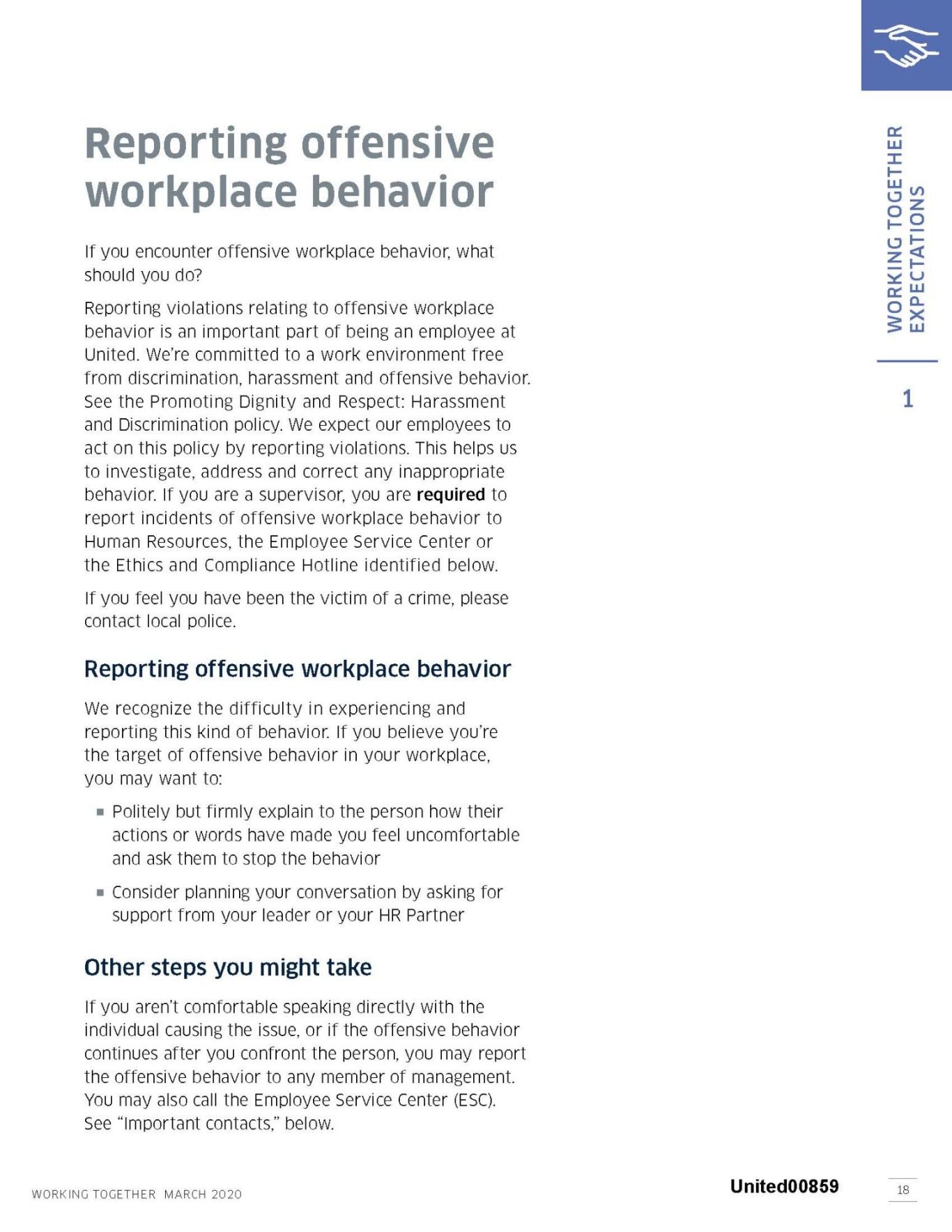
United’s own Working Together Guidelines
Indeed, United’s own Working Together Guidelines expressly encourage precisely the conduct
FA Blockhus undertook. As stated on page 18 of those guidelines: “If you believe you’re the
target of offensive behavior in your workplace, you may want to politely but firmly explain to
the person how their actions or words have made you feel uncomfortable and ask them to stop
the behavior.” FA Blockhus’s voicemail did exactly that—he communicated directly, calmly,
and appropriately, asking that the conduct cease and advising that he would report the matter if it
continued.
Despite this clear policy guidance and United’s sworn admission that the call was acceptable,
United later recast the same voicemail as misconduct and cited it as an aditional basis for
termination. This reversal exposes a fundamental inconsistency and demonstrates pretext. An
employer cannot deem conduct acceptable under its own policies and then retroactively weaponize that same conduct to justify termination.
United’s selective and contradictory reliance on this voicemail—first acknowledging it as compliant, then treating it as culpable—further confirms that the investigation was outcomedriven rather than evidence-based, violated the just-cause and due-process requirements of the Collective Bargaining Agreement, and underscores that the termination decision rested on post hoc rationalizations, not legitimate misconduct.
In later testimony FA Lense states; “Before January 25, no I did not have a reason to report Blockhus to the company” and again she appeared to focus her claim solely on her concern for her job security. In her own testimony, FA Lense admitted her primary motivation was to protect her job in light of allegations that she had created a hostile work environment toward Blockhus., stating:
"I felt like I wanted to protect myself, went to the company, and told them I was being accused of a hostile work environment”
“I didn't want anybody to get in trouble”,
“ I was simply trying to protect my job."
“My biggest issue was the threat to my job”
“I didn’t think anything of it until he brought the company into it, I don’t want him to lose his job”
“I didn’t want anyone in trouble, I was simply trying to protect my job”
This illustrates her intention to clarify her position and safeguard her employment.
FA Blockhus had no knowledge of any communications FA Lense was making to United management until on February 4th 2021 he was suddenly removed from his work schedule and accused by management of “harassing” FA Lense. Prior to that point, he had not been informed of any complaint, investigation, or allegations against him. Even then, FA Blockhus was provided only a limited and incomplete summary of the accusations. Management shared merely a small sample of the complainant’s claims, consisting of a few quoted excerpts from alleged text messages he was purported to have sent. He was not provided the full allegations, the complete evidence, the context of the claims and was told he can not know the details of his case until four days later on February 8th. Upon learning he was being accused of harassment, FA Blockhus immediately contacted his supervisor and left a voicemail in which he explicitly denied the allegations, stating that FA Lense’s claims were “ridiculous” and explaining that she was retaliating against him because he had threatened to report her harassment to the company. Despite this clear denial, United later asserted in an apparent act of bias—without factual support—that FA Blockhus had “admitted guilt” in this voicemail. This characterization is demonstrably false. At no point did FA Blockhus concede misconduct; to the contrary, his message expressly rejected the allegations and identified a retaliatory motive behind FA Lense’s complaint. Later that same day, FA Blockhus was contacted by his supervisor, Ms. Howell, who informed him that because corporate security was involved, his only recourse to keep his job at United was to submit a statement of apology to management for “involving the company”—a fact United later admitted. At the time, FA Blockhus had not been provided full notice of the allegations, the complete evidence, or the scope of the charges against him.
FA Blockhus, who suffers from clinically diagnosed anxiety, experienced a severe emotional response upon being confronted with the unexpected accusation. In a state of acute distress, he attempted to clarify and explain the situation, while making every effort to treat Ms. Lense respectfully and avoid portraying her negatively. This incident occurred in the immediate aftermath of the Women’s March on Washington, a context in which FA Blockhus believed it was appropriate to approach the matter with heightened sensitivity and to view FA Lense in a positive and respectful manner.
However, at no point in FA Blockhus’s statement—whether ill-advised, confused, or conciliatory—did he admit to sending the alleged text messages submitted by FA Lense. United’s later characterization of his statement as an “admission” is factually inaccurate and unsupported by any direct quotation or evidence. United management later asserted that FA Blockhus’s statement was submitted outside the scope of its established disciplinary process and before he had received complete notice of the charges, and therefore could not be treated as an official statement. In fact, once FA Blockhus was able to better understand the situation and the nature of the allegations, he promptly rescinded the ill-advised statement and expressly advised United that it did not represent his official position. Despite this clarification and withdrawal, as well as being outside the established process, United improperly continued to rely on and distort the rescinded statement, further demonstrating procedural unfairness, mischaracterization of the record, and bad faith in violation of the just-cause and due-process protections guaranteed by the Collective Bargaining Agreement. This position is untenable. FA Blockhus submitted the statement only because he was instructed to do so by his supervisor and under the express representation that it was necessary to preserve his employment.
FA Blockhus’s health rapidly deteriorated, and on the morning of February 8, 2021, members of his Union placed him into the care of the Employee Assistance Program (EAP), where he received assistance in applying for his entitled FMLA leave. His FMLA request was approved, and he was immediately admitted to a rehabilitation clinic in Jacksonville, Florida.
Following FA Blockhus’s disclosure of his medical condition and entry into treatment, Monique Williams, United Airlines’ Base Manager at Washington Dulles International Airport (IAD)—where FA Blockhus was based—formally conferred and negotiated with the Association of Flight Attendants (AFA) to postpone any disciplinary proceedings until Mr. Blockhus returned from approved FMLA leave.
Pursuant to that agreement, Ms. Williams issued a directive to all involved United personnel expressly stating that FA Blockhus was “unavailable” and that the investigation was to be postponed until the conclusion of his FMLA leave. This directive was circulated to those responsible for the investigation and disciplinary process and reflected United’s acknowledgment of FA Blockhus’s contractual and statutory right to be free from disciplinary action while medically unable to participate.
This agreement and directive are critical. They confirm that United:
1. Recognized FA Blockhus’s protected FMLA status,
2. Acknowledged the necessity of his participation for a fair investigation, and
3. Affirmatively agreed to suspend the disciplinary process in accordance with the Collective
Bargaining Agreement and federal law.
United’s later decision to disregard this agreement and proceed with the investigation and
termination in absentia, while FA Blockhus remained on approved FMLA leave, directly
contradicts its own directive and constitutes a knowing breach of the Collective Bargaining
Agreement, interference with FMLA rights, and a denial of fundamental due process. This
sequence further evidences pretext and bad faith, rendering the termination procedurally and
legally invalid.
The individuals involved in the investigation were made aware of this directive as early as
February 10, 2021. This directive confirms that United expressly acknowledged FA Blockhus’s
contractual and due-process rights, including the requirement that he be available to
participate in any disciplinary investigation, as mandated by the Collective Bargaining
Agreement.
FA Blockhus’s approved FMLA leave ran from February 8 through April 5, 2021. Despite
this, and the fact base manager Monique Williams directive, United proceeded to terminate him
within just days, in absentia on or about February 26, 2021, while he remained hospitalized
and medically unavailable. The termination decision was made by Frank Hester a junior flight attendant that was temporarily assigned in a low level supervisory role that had no connection
with any investigation.
Hester later testified for his reason to terminate Blockhus;
“So I relied on the text messages, the voice message, the letter of investigation, the
initial, the revised, the statement that Mr. Blockhus submitted.”
This action was taken notwithstanding lead investigator John McCormick’s own admission
that “I need to interview Blockhus.”
United (Frank Hester) nevertheless concluded the “investigation” and terminated FA Blockhus
without ever interviewing him, affording union representation, or providing him an
opportunity to respond to the full scope of the allegations against him. These failures raise
serious concerns regarding the procedural fairness, contractual compliance, and legitimacy
of the termination decision under the Collective Bargaining Agreement. Significantly, after the
termination, United’s legal team later offered FA Blockhus the option to resign from his
position as a flight attendant in lieu of termination. This post-hoc offer further undermines
United’s stated justification for discharge and supports an inference that the termination decision
was procedurally defective, legally vulnerable, and not supported by just cause.
⚖Available Supporting Evidence:
• Base Managers Directive to postpone
• Written Employment Contract (CBA)
• Management e-mail correspondence
• Management sworn recorded testimonies
• Management e-mail correspondence
• Resignation letter offered by United Management
• Ms. Lense Sworn documented testimony
• Blockhus FMLA Medical Documents
• AFA Union Statements of Contract Violation
• Video and Audio Recordings of Lense
• Witness sworn Testimony
• Blockhus phone records
• Ms. Lense threating text to Blockhus
• Blockhus 24 year employment record history
Failure to Verify or Question Allegations
1. United Airlines never required any authentication or proof for the allegations made by FA Lense
against FA Blockhus. The company accepted her unverified claims and unauthenticated text
messages without conducting any independent verification—no phone-number confirmation, no
metadata review, no corroborating evidence, and no assessment of credibility. This failure to
authenticate or substantiate evidence before taking adverse action violates both the just-cause
standards of the Collective Bargaining Agreement (CBA) and the employer’s duty to make a
reasonably informed and considered decision.
Under Smith v. Chrysler Corp., 155 F.3d 799 (6th Cir. 1998).
By relying solely on unauthenticated materials, United acted in bad faith, rendering the
investigation procedurally defective and the termination decision arbitrary and unlawful.
2. FA Blockhus was never even asked whether he sent the alleged text messages before United
wrongfully terminated his employment. It was stated under oath multiple times that no one at
United spoke with FA Blockhus at anytime of the “investigation.” United relied on these
unauthenticated messages as a central basis for its decision without ever questioning FA Blockhus,
requesting an explanation, or permitting him to respond to the full accusations against him. United’s
failure to ask FA Blockhus about the alleged text messages before terminating him constitutes a
fundamental denial of due process and a clear breach of the Collective Bargaining Agreement’s justcause and investigative requirements. It also demonstrates that United did not make a reasonably
informed and considered decision, rendering its stated justification pretextual and legally insufficient.
3. Despite relying heavily on unauthenticated screenshot images displaying no date or phone number as
the central basis for termination, United Airlines knew that FA Blockhus was hospitalized on
approved FMLA leave that there was an agreement to postpone, nonetheless made no effort to
question him, interview him, or allow him to respond to the full allegations. United proceeded to
terminate his employment in absentia, without notice of the complete charges, without access to the
evidence, and without affording him any opportunity to be heard. This conduct constitutes a clear
denial of due process, interference with protected FMLA rights, and a material breach of the
Collective Bargaining Agreement’s just-cause and investigation requirements. It further
demonstrates that United’s decision was not reasonably informed, but instead based on unchecked,
unauthenticated evidence, rendering the termination procedurally unlawful and pretextual.
⚖ Supporting Case Law
• McDonnell Douglas Corp. v. Green, 411 U.S. 792 (1973)
o Holding: Established that once an employee presents a prima facie case of discrimination
or wrongful action, the employer must provide a legitimate, non-pretextual reason for its
decision.
o Relevance: If an employer relies on unverified or unauthenticated evidence without
questioning the accused employee, it suggests the stated reason was pretextual rather
than legitimate.
o Key Quote:
“The employer must articulate legitimate, non-discriminatory reasons for its actions,
supported by specific facts rather than mere assertions.”
• Reeves v. Sanderson Plumbing Products, Inc., 530 U.S. 133, 148 (2000)
o Holding: When an employer’s explanation for termination is unsupported by evidence or
contradicted by the record, a factfinder may reasonably conclude the employer’s stated
reason is pretext for unlawful action.
o Relevance: Reliance on unauthenticated text messages while ignoring the employee’s
right to respond mirrors the kind of pretext condemned in Reeves.
⚖ Key Legal Points:
United’s failure to even inquire with FA Blockhus about the alleged text messages before terminating him demonstrates a complete denial of due process and a clear breach of the Collective Bargaining
Agreement (CBA). It also exposes the company’s “investigation” as a predetermined and procedurally
defective process conducted in bad faith.
United Airlines’ termination of FA Blockhus was procedurally and substantively unlawful. The simple
fact FA Blockhus was never even asked whether he sent the alleged text messages prior to his
discharge is substantial. United relied solely on unauthenticated, unverified evidence as the central basis
for termination, without questioning him, allowing a response, or conducting any meaningful investigation. Such conduct fails the standard of a “reasonably informed and considered decision” as established in Smith v. Chrysler Corp., 155 F.3d 799 (6th Cir. 1998), and demonstrates that United’s stated justification was pretextual, not legitimate, under McDonnell Douglas Corp. v. Green, 411 U.S. 792 (1973), and Reeves v. Sanderson Plumbing Prods., Inc., 530 U.S. 133 (2000).
Protected Activity – Reporting Harassment
On January 24, 2021, and again on January 25, 2021, at 10:58 a.m.
FA Blockhus left a voicemail for a fellow employee and former girlfriend, FA Lense. In that message, he informed her that if she did not cease her harassment of him and another co-worker, they would report her behavior to the company. The purpose of these communications was protective and corrective, not punitive. Mr. Blockhus did not threaten Ms. Lense, her safety, or her employment; rather, he advised her of a lawful and policy-compliant course of action—reporting workplace harassment—if the conduct continued. United later acknowledged that this communication did not violate company policy and that an employee may inform another employee of an intent to report misconduct to Human Resources.
Why This Matters:
• Not Misconduct: FA Blockhus’s voicemail was not threatening; it was a warning to stop
harassment and a notice that her conduct would be reported.
• Policy-Compliant: United later admitted that such a message was acceptable under company
policy then turned around and used it for further justification to terminate Blockhus.
• Protected Activity: Reporting or warning about workplace harassment is protected activity
under both the CBA and federal law.
• Retaliatory Motive: Immediately after Blockhus call warning Ms. Lense to stop her
harassment, she filed a retaliatory complaint against him in order to, as she has testified, “protect
her job”.
o Her initial claim was limited to saying FA Blockhus had “threatened her employment.”
o Only later did she submit false, altered text message screen shots — which contained no
phone number, no dates, and no authentication.
o Despite the lack of verification, United accepted her submissions without scrutiny and
used them as the basis to justify termination.
⚖ Key Argument:
The sequence of events — FA Blockhus reporting harassment, followed immediately by FA Lense retaliatory complaint, and her later reliance on unauthenticated texts — demonstrates a clear retaliatory motive. United’s reliance on this shifting, unverified evidence shows bad faith, pretext, and a violation of contractual and statutory protections. The voicemail was a legitimate workplace report of harassment, not a policy violation. United’s use of this protected activity as a basis for termination even after stating it was acceptable under United policy, highlights retaliation and pretext.
Retaliation Sequence Timeline
January 24–25, 2021
- Protected Activity:
o FA Blockhus leaves two voicemails for Ms. Lense (Jan. 24 and Jan. 25, 10:58 a.m.).
o Purpose: To tell her to stop harassing him and co-worker Mindy Richard, or her
behavior would be reported to United.
o United later admitted this type of message was policy-compliant but then later claims it
was justification for termination - Immediately After the Jan. 25th Call - Retaliatory Complaint Filed:
o FA Lense immediately contacts United to file a claim against Blockhus.
o First claim: FA Blockhus “threatened her employment.”
o FA Lense focus was solely on her job security, not harassment or fear, that she later
admitted in her sworn testimony.
o This fact was later proven in both Lense and McCormic’s sworn testimonies. - Subsequent Actions
• Shifting Story:
o FA Lense later submits screenshots of unauthenticated text message.
o These texts lacked:
Phone number
Dates/year
No Authentication or corroborating evidence
o Even FA Lense herself testified: “I can’t remember for sure… I don’t remember
exactly what it was all about.” This admission shows that she could not recall the
context, content, or circumstances of the alleged text messages that United relied upon
to terminate FA Blockhus.
⚖ Key Legal Significance:
FA Lense inability to remember the details of her claims of alleged misconduct undermines the credibility and reliability of the accusations. When the sole complainant cannot recall what the supposed messages were about, and when no authentication or corroboration exists, any termination based on such evidence is arbitrary, unsupported, and a violation of just-cause standards under the Collective Bargaining Agreement. This also reinforces that United’s reliance on these vague, unauthenticated screenshots was pretextual and procedurally defective.
United ignored its own directive to postpone the investigation until Mr. Blockhus FMLA leave ended.
The Collective Bargaining Agreement (CBA §§ 23 A.7) sets a 30-day deadline for management to issue discipline after becoming aware of an incident. However, the agreement also provides flexibility when the Flight Attendant is unavailable:
1. If the Flight Attendant requests to postpone an investigatory meeting,
2. Or is on leave of absence, furlough, or vacation lasting more than 14 days,
➡ Then the 30-day disciplinary clock is automatically extended by the length of the absence or postponement
Automatic Extension of the Disciplinary Timeframe
- Under the applicable disciplinary provisions, the 30-day disciplinary clock is automatically extended by the full length of the employee’s absence or any approved postponement. When an employee is on a leave of absence—including medical leave, FMLA, furlough, or a requested postponement—the employer is not permitted to proceed as if the time continues to run. Instead, the disciplinary deadline is tolled and resumes only after the employee becomes available.
- This provision directly defeats any claim that United was under time pressure to complete the
investigation while FA Blockhus was on approved FMLA leave. Because the clock was
automatically extended by the duration of his medical unavailability, United had no contractual
justification for proceeding in absentia. Any termination issued during that period violated the
CBA’s timing provisions and further demonstrates that United chose expediency over compliance
with contractual due-process requirements.
- Lead investigator John McCormick admitted he was aware of the agreed postponement and that
FA Blockhus was medically unavailable and could not participate in the investigation. Despite
this knowledge—and despite the automatic extension provision—United (McCormick) chose to
proceed in absentia, never interviewed FA Blockhus, and completed the investigation based solely
on unverified, complainant-supplied materials. United’s invocation of timing concerns was
therefore false and pretextual, serving only to justify a rushed termination in violation of the
CBA’s due-process, participation, and just-cause requirements. This deliberate disregard of the
tolling provision further demonstrates that United substituted expediency for contractual
compliance, rendering the investigation and termination procedurally invalid.
⚖Why This Matters:
• Direct Admission: McCormick knew United had formally acknowledged that FA Blockhus was
unavailable during his FMLA leave and the mutually agreed upon postponement.
• CBA Violation: The agreement required that Blockhus participation in any investigation — yet United proceeded without him.
• Evidence of Bad Faith: United disregarded its own written directive, proving the investigation and termination were rushed and pretextual.
⚖ Key Argument:
This clause explicitly protects employees like FA Blockhus who are unavailable due to leave (including FMLA). Since United knew he was on approved FMLA leave and medically unavailable, they were contractually obligated to pause and extend the investigation timeline until his return. By instead proceeding in absentia and terminating him, United not only denied him due process but also violated the CBA’s express postponement rule. United knowingly proceeded with termination while FA Blockhus was unavailable on protected FMLA leave — despite its own directive to wait until April 5. This was a clear breach of contract, denial of due process, and interference with federal FMLA rights.
United relied on Ms. Lense to decide what evidence was
relevant for an investigation.
Investigator Abdicated Independent Fact-Finding Responsibilities
Lead Investigator John McCormick deferred entirely to FA Lense’s selective submissions, rather than conducting an independent and objective review of the facts. He failed to examine records, authenticate evidence, seek corroborating witnesses, or independently assess the credibility of the allegations. Instead, he accepted only what Ms. Lense chose to provide and relied on her characterization of events to shape the investigation’s scope and outcome.
⚖Why This Matters:
• An investigation that relies on the complainant to determine what evidence is relevant— without independent verification or inquiry—fails basic standards of neutrality, due process, and just cause. McCormick’s abdication of investigative responsibility further demonstrates that United’s process was biased, complainant-driven, and pretextual, rendering the termination decision contractually and legally invalid.
• Bias & Lack of Neutrality: Allowing the complainant to filter and frame the evidence is the opposite of an impartial investigation.
• Contractual Violation: The CBA required a fair, fact-driven process with equal opportunity for the accused to participate — not a one-sided review dictated by the accuser.
• Due Process Failure: By outsourcing relevance to Lense, United denied FA Blockhus’s contractual right to confront evidence and present rebuttal.
• Legal Weakness: Courts hold that investigations dominated by the accuser cannot form the basis of a legitimate “honest belief” defense (see Smith v. Chrysler Corp., 155 F.3d 799 (6th Cir. 1998) — employer must reasonably rely on independently verified facts).
• Disregard for Evidence of Retaliatory Motive. The timing of Lense’s claim was clear, -just moment after FA Blockhus left her a voice message that she would be reported to the company if she did not stop harassing him. In FA Lense own intake interview she stated she was only concerned about losing her job.
• United accepted all of Ms. Lense’s statements and submitted evidence without conducting proper scrutiny, verification, or authentication
⚖ Key Argument:
Biased and Procedurally Defective Investigation
United’s investigation was fundamentally biased and procedurally defective, falling far short of the standards required by the Collective Bargaining Agreement and basic principles of fairness. United failed to authenticate critical evidence, declined to interview the accused, and refused to apply equal scrutiny to competing accounts. Instead of engaging in a balanced inquiry, United accepted unverified allegations at face value, relied on unauthenticated materials lacking basic identifying information, and permitted the complainant to control the narrative and scope of the investigation.
Most notably, United excluded FA Blockhus from the investigative process entirely. He was not informed of the full allegations, was denied the opportunity to present evidence or respond meaningfully, and was not afforded union representation before adverse action was taken. Proceeding in this manner—particularly while FA Blockhus was medically unavailable and on approved FMLA leave—demonstrates that United abandoned its obligation to conduct a fair and neutral inquiry in favor of expediency and predetermined conclusions.
This conduct violated the CBA’s mandatory requirements for due process, just cause, employee participation, and investigative integrity, as well as fundamental principles of fairness that govern disciplinary proceedings. By substituting assumption for investigation, selective acceptance for reasoned evaluation, and alignment with the accuser for neutrality, United rendered its termination decision contractually invalid and legally unsustainable. The resulting discharge was not the product of a fair process or just cause, but of a biased, outcome-driven investigation that cannot withstand legal scrutiny.