Violations of the Collective Bargaining Agreement
United Airlines’ handling of this matter reflects multiple violations of the procedural protections and requirements set forth in the governing Collective Bargaining Agreement (“CBA”). These provisions are designed to ensure fairness, consistency, and due process in the investigation and discipline of employees. In this case, those protections were not followed.
First, the CBA requires that any disciplinary action be based on a fair and impartial investigation. This includes the obligation to gather and evaluate all relevant evidence, interview key witnesses, and provide the accused employee with a meaningful opportunity to respond. United failed to meet these requirements. FA Blockhus was never interviewed prior to his termination, and critical evidence—including phone records, witness testimony, and exculpatory communications—was either disregarded or omitted entirely.
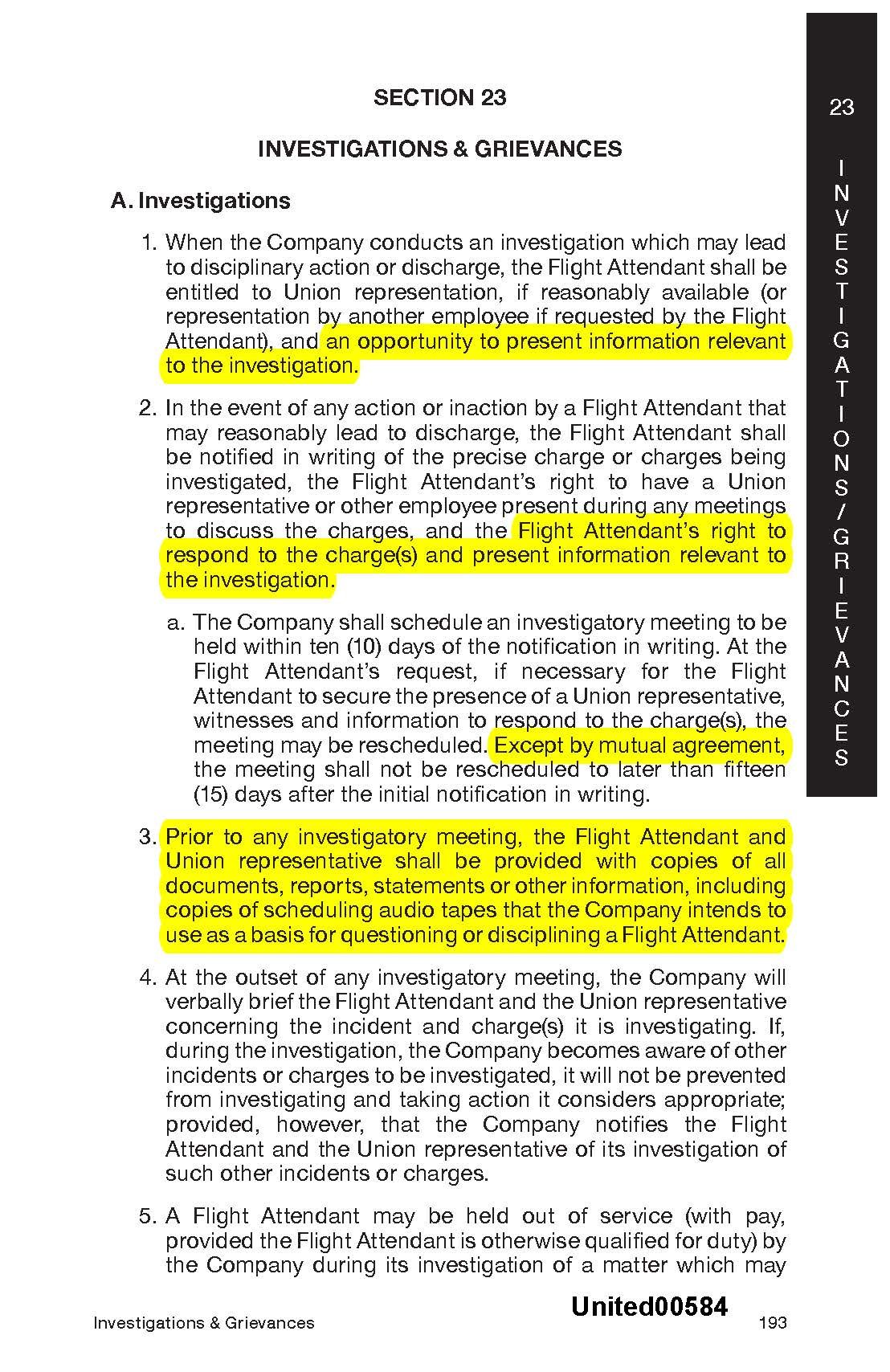
Second, the CBA guarantees that an employee will be provided with notice of the allegations and access to the evidence being used against them prior to any investigatory meeting or disciplinary determination. In this case, FA Blockhus was never provided with the full body of evidence, nor was he given a meaningful opportunity to review and respond to the claims before action was taken.
Third, the CBA requires that disciplinary decisions be supported by just cause and based on reliable, verified evidence. United relied on unverified text messages that were not authenticated and, in some instances, were not connected to FA Blockhus at all. Despite the availability of objective evidence contradicting these claims, United proceeded without conducting proper verification, thereby failing to meet the just-cause standard.
Fourth, the CBA requires consistency in the application of disciplinary standards. The record demonstrates that comparable or more serious conduct by FA Lense—including repeated contact, documented harassment, and other misconduct—was not investigated or disciplined. This inconsistent application of policy reflects disparate treatment and further violates the principles embodied in the agreement.
Fifth, the CBA provides for a structured grievance and arbitration process intended to ensure a fair and final resolution of disputes. In this case, that process was never completed. No final arbitration award was issued, and no binding decision was rendered, leaving the matter unresolved and depriving FA Blockhus of the full protections afforded under the agreement.
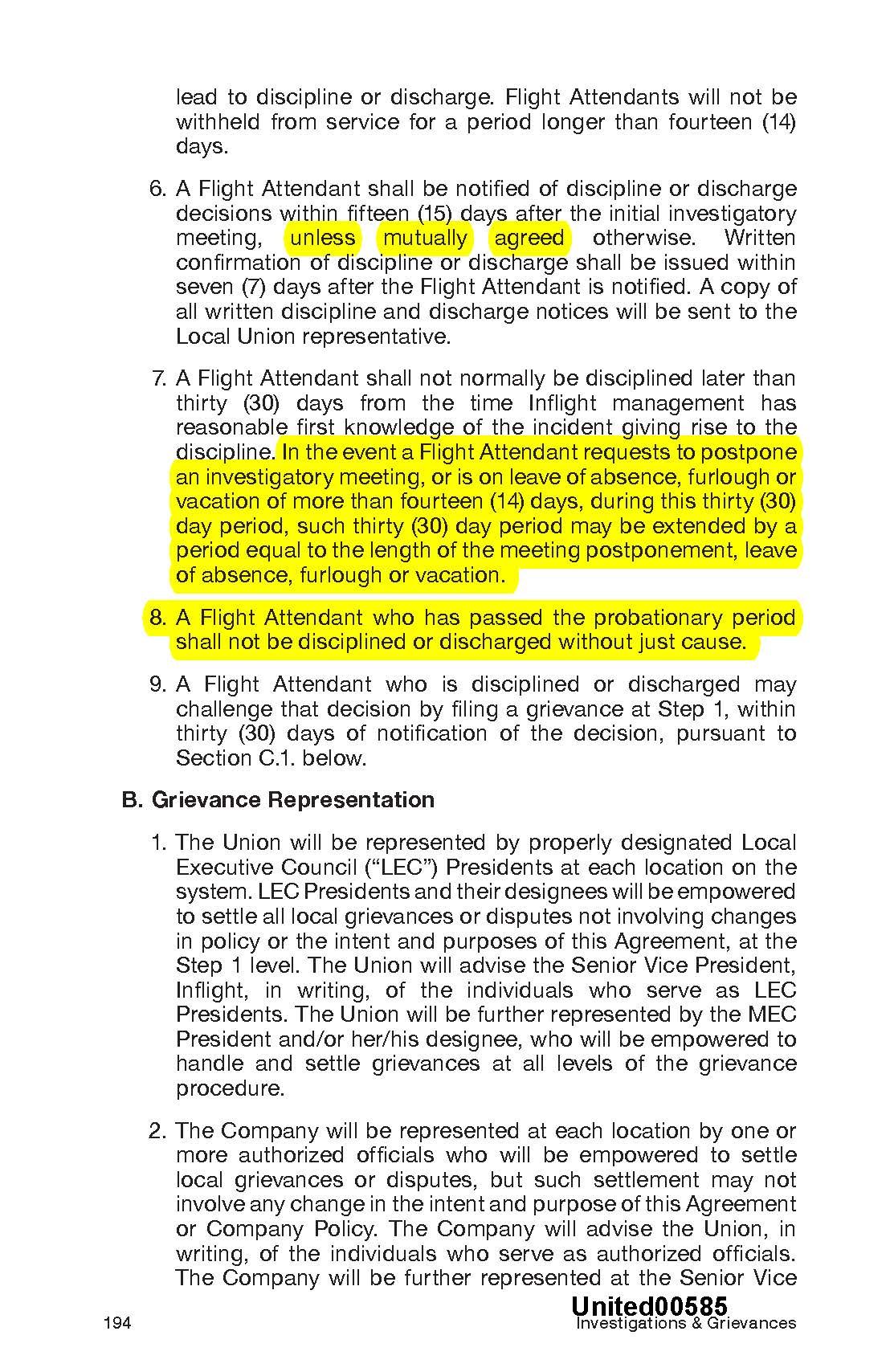
Finally, United’s own internal communications confirm that an agreement was reached to postpone the investigation until FA Blockhus was available to participate, consistent with the requirements of the CBA. Despite this, United proceeded in his absence, in direct violation of both that agreement and the contractual obligation to provide a fair and participatory process.
Taken together, these violations demonstrate a systemic failure to adhere to the contractual safeguards designed to protect employees from arbitrary and unjust discipline. The failure to follow these provisions rendered the investigation incomplete, one-sided, and procedurally defective, and the resulting termination cannot be sustained under the terms of the Collective Bargaining Agreement.
Breach of Written Employment Contract (CBA)
• Wrongful termination without just cause.
• Failure to allow participation in own investigation.
• After an agreement to contractually postpone due to FMLA medical leave, conducted a shame
investigation while Blockhus was unavailable, Ignoring protections under CBA §§ 21.C
(rehabilitation), 23.A (investigations), 29.A(f) (health and welfare).
• At minimum, Blockhus was never even interviewed.
• Lack of Notice and Full acknowledgement of Charges
o Mr. Blockhus was never allowed to respond within the scope of an investigation or able
to reviewed or had full knowledge of the case against him prior to his termination due to
his FMLA leave.
o Blockhus had not seen the complete allegations or any evidence before United reached its
decision of termination.
o Blockhus was only informed there was some ambiguous argument with Lense involving
text messaging.
o “The essential requirements of due process are notice and an opportunity to respond
… The tenured public employee is entitled to oral or written notice of the charges
against him, an explanation of the employer’s evidence, and an opportunity to present
his side of the story.” — Loudermill, 470 U.S. at 546
⚖ Key Legal Point:
These omission’s constitutes a violation of due process and the CBA’s procedural safeguards, which require that an employee be fully informed of the allegations and given a fair chance to respond. United’s actions deprived Mr. Blockhus of his contractual and legal right to defend himself, further demonstrating that his termination was procedurally invalid and pretextual.
Even though Loudermill dealt with public employment, courts often cite it when evaluating procedural fairness and just-cause standards under collective bargaining agreements (CBAs). Like Loudermill, Mr. Blockhus was deprived of both notice and the opportunity to respond to the full allegations before his termination — clear violations of the CBA’s due-process protections and the implied covenant of fair dealing.
⚖ Legal Argument:
United Airlines’ termination of Mr. Blockhus was procedurally and substantively unlawful. Mr. Blockhus was never even interviewed nor asked whether he committed the alleged allegation against him prior to his discharge. United relied solely on a phone statement, and unauthenticated, unverified screenshot as the central basis for termination, without questioning him, allowing a response to the full allegations and evidence, or conducting any meaningful investigation. Such conduct fails the standard of a “reasonably informed and considered decision” as established in Smith v. Chrysler Corp., 155 F.3d 799 (6th Cir. 1998), and demonstrates that United’s stated justification was pretextual, not legitimate, under McDonnell Douglas Corp. v. Green, 411 U.S. 792 (1973), and Reeves v. Sanderson Plumbing Prods., Inc., 530 U.S. 133 (2000).
Furthermore, as in DaPrato v. Massachusetts Water Resources Authority, 482 Mass. 375 (2019), the employer terminated an employee on protected FMLA leave without ever hearing his side of the story. United’s failure to verify evidence or authenticate a screenshot of a text message that lacked a phone number, date, or any circumstantial evidence nor afforded Mr. Blockhus a chance to respond constitutes a denial of due process and bad-faith breach of the written Collective Bargaining Agreement, invalidating its so-called “honest belief” and “he would have been fired anyway” defense.
Contractual & Procedural Rights Under the CBA
The Collective Bargaining Agreement (CBA) required that Blockhus be afforded:
- Due Process – a fair and transparent investigation before any discipline or termination.
- Just Cause Requirement–Under the Collective Bargaining Agreement (CBA),
termination is permitted only for legitimate, evidence-based reasons.
o Not “He would have been fired anyway” – This is speculative and not recognized under
his CBA written employment contract.
o Not “Honest Belief” – An employer’s subjective belief cannot substitute for objective,
verified evidence.
o CBA Standard – Requires just cause, which includes:
1. A fair and thorough investigation.
2. Reliable, authenticated evidence.
3. The employee’s right to participation and representation.
4.The opportunity to respond only after being fully informed of the charges and evidence against him.
⚖ Key Argument:
United’s reliance on post-hoc rationalizations such as “he would have been fired anyway” and “honest belief” does not satisfy the Collective Bargaining Agreement’s contractual requirement of just cause. Neither rationale appears anywhere in the CBA as a permissible basis for discipline or discharge. Just cause under the agreement requires a reasonable, good-faith investigation, supported by reliable evidence, conducted with notice, participation, union representation, and an opportunity for the employee to respond. United provided none of these protections.
The assertion that Mr. Blockhus “would have been fired anyway” is legally insufficient and inherently
speculative. Courts and arbitrators consistently reject such hindsight justifications, particularly where the employer failed to conduct a lawful investigation in the first place. United cannot excuse procedural violations by asserting that the outcome was inevitable; doing so nullifies the contractual safeguards that the CBA was designed to guarantee.
Similarly, United’s invocation of an “honest belief” defense fails as a matter of both contract and law. An
honest belief must be grounded in a reasonable and informed inquiry. Here, United formed its alleged belief without interviewing Mr. Blockhus, without authenticating critical evidence, without assessing credibility, and while excluding him entirely from the process—despite knowing he was on approved FMLA leave and medically unavailable. A belief formed by willful ignorance and one-sided assumptions cannot be deemed honest, reasonable, or contractually valid.
By relying on these unsupported excuses, United exposed the termination as pretextual rather than
evidence-based.
Contractual & Procedural Rights Under the CBA
The Collective Bargaining Agreement (CBA) required that Blockhus be afforded:
1. Due Process – a fair and transparent investigation before any discipline or termination.
2. Just Cause Requirement–Under the Collective Bargaining Agreement (CBA),
termination is permitted only for legitimate, evidence-based reasons.
o Not “He would have been fired anyway” – This is speculative and not recognized under
his CBA written employment contract.
o Not “Honest Belief” – An employer’s subjective belief cannot substitute for objective,
verified evidence.
o CBA Standard – Requires just cause, which includes:
* A fair and thorough investigation.
* Reliable, authenticated evidence.
*The employee’s right to participation and representation.
*The opportunity to respond only after being fully informed of the charges and evidence against him.
⚖ Key Argument:
United’s reliance on post-hoc rationalizations such as “he would have been fired anyway” and “honest belief” does not satisfy the Collective Bargaining Agreement’s contractual requirement of just cause. Neither rationale appears anywhere in the CBA as a permissible basis for discipline or discharge. Just cause under the agreement requires a reasonable, good-faith investigation, supported by reliable evidence, conducted with notice, participation, union representation, and an opportunity for the employee to respond. United provided none of these protections.
The assertion that Mr. Blockhus “would have been fired anyway” is legally insufficient and inherently
speculative. Courts and arbitrators consistently reject such hindsight justifications, particularly where the
employer failed to conduct a lawful investigation in the first place. United cannot excuse procedural
violations by asserting that the outcome was inevitable; doing so nullifies the contractual safeguards that the CBA was designed to guarantee.
Similarly, United’s invocation of an “honest belief” defense fails as a matter of both contract and law. An
honest belief must be grounded in a reasonable and informed inquiry. Here, United formed its alleged belief without interviewing Mr. Blockhus, without authenticating critical evidence, without assessing credibility, and while excluding him entirely from the process—despite knowing he was on approved FMLA leave and medically unavailable. A belief formed by willful ignorance and one-sided assumptions cannot be deemed honest, reasonable, or contractually valid. By relying on these unsupported excuses, United exposed the termination as pretextual rather than evidence-based.